2026 Antarctic Ozone Hole Averaged 24.9 Million km² Under an Unusually Stable Polar Vortex
After a moderate 2025 season (18.7M km²), stratospheric weather made 2026 the 7th-largest ozone hole in 48 years of satellite records.
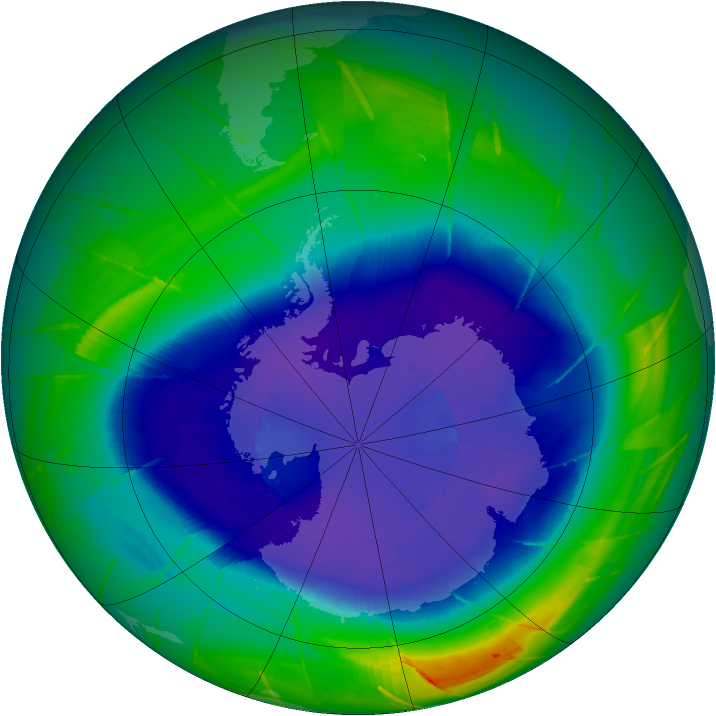
NOAA and NASA observations show the 2026 Antarctic ozone hole averaged roughly 9.6 million square miles (~24.9 million km²) between September 7 and October 13—ranking 7th-largest in 48 years of tracking due to an unusually cold, stable polar vortex.
- Averaged ~9.6 million sq mi (~24.9 million km²) in Sept–Oct 2026 (7th-largest in 48 years).
- Contrasts sharply with 2025, which averaged ~7.23 million sq mi (~18.7 million km², 5th-smallest since 1992).
- Despite 2026's weather-driven spike, long-term ozone recovery under the Montreal Protocol remains on track.
Mean Antarctic Ozone Hole Area (2025 vs. 2026)
Million square kilometers during core depletion window
Source: NOAA / NASA (converted from 9.6M sq mi in 2026 and 7.23M sq mi in 2025).
Why 2025 and 2026 differed so sharply even as ozone-depleting chemicals fall
Every Southern Hemisphere spring (September–October), returning sunlight triggers chemical ozone destruction on polar stratospheric clouds above Antarctica. However, year-to-year hole size depends heavily on stratospheric winds and temperatures.
In 2025, a weaker, warmer polar vortex kept the hole moderate at 7.23 million sq mi (~18.7M km²). In 2026, an exceptionally strong, cold polar vortex locked frigid air over Antarctica, expanding the average hole to ~9.6 million sq mi (~24.9M km²).
2025 vs. 2026 in 48-year context
As illustrated in the comparison chart, the gap between 2025 and 2026 exceeds 6 million square kilometers, placing 2026 as the 7th-largest hole in 48 years of monitoring.
NOAA and NASA researchers stress that without the Montreal Protocol phasing out CFCs, weather conditions like 2026's would have produced a vastly larger ozone hole.
Long-term healing trajectory remains intact
Single-season meteorological swings do not reverse the underlying downward trend in stratospheric chlorine and bromine, keeping full Antarctic ozone recovery projected around mid-century.
Frequently asked questions
Does a larger 2026 ozone hole mean the Montreal Protocol failed?+
No. The swing between 2025 (18.7M km²) and 2026 (24.9M km²) reflects colder, more stable polar vortex weather in 2026 rather than rising CFC emissions.
How long have satellites tracked the Antarctic ozone hole?+
NOAA and NASA maintain a 48-year continuous satellite ozone record stretching back to the late 1970s.
Verification Fact Sheet
Original source: NOAA / NASA Goddard Ozone Watch
Evidence: Satellite ozone monitoring (Sept 7 – Oct 13 window, 2026 vs 2025).
Scope: Mean ozone hole area: ~24.9M km² (2026) vs ~18.7M km² (2025).
Announced date: Oct 2026