ESA's Hera Mission Arrives at the DART-Impacted Asteroid System in November 2026
Operating 25 to 30 km from Didymos and Dimorphos, Hera will inspect the 2022 impact crater and deploy two CubeSats.
Launched in October 2024, the European Space Agency's Hera spacecraft arrived at the Didymos–Dimorphos binary asteroid system in November 2026—roughly a month ahead of schedule—beginning operations at 25–30 km to survey DART's impact site.
- Arrived at Didymos–Dimorphos in November 2026 following deep-space braking maneuvers.
- Early characterization orbit spans 25 to 30 kilometers from the binary pair.
- Carries companion CubeSats Milani and Juventas to probe surface minerals and interior radar structure.
Hera Standoff Orbit vs. Binary Asteroid Scale
Comparative scale in kilometers (km)
Source: ESA Hera · The 25–30 km early orbit keeps both Didymos and Dimorphos in view.
Why returning to the impact scene was essential
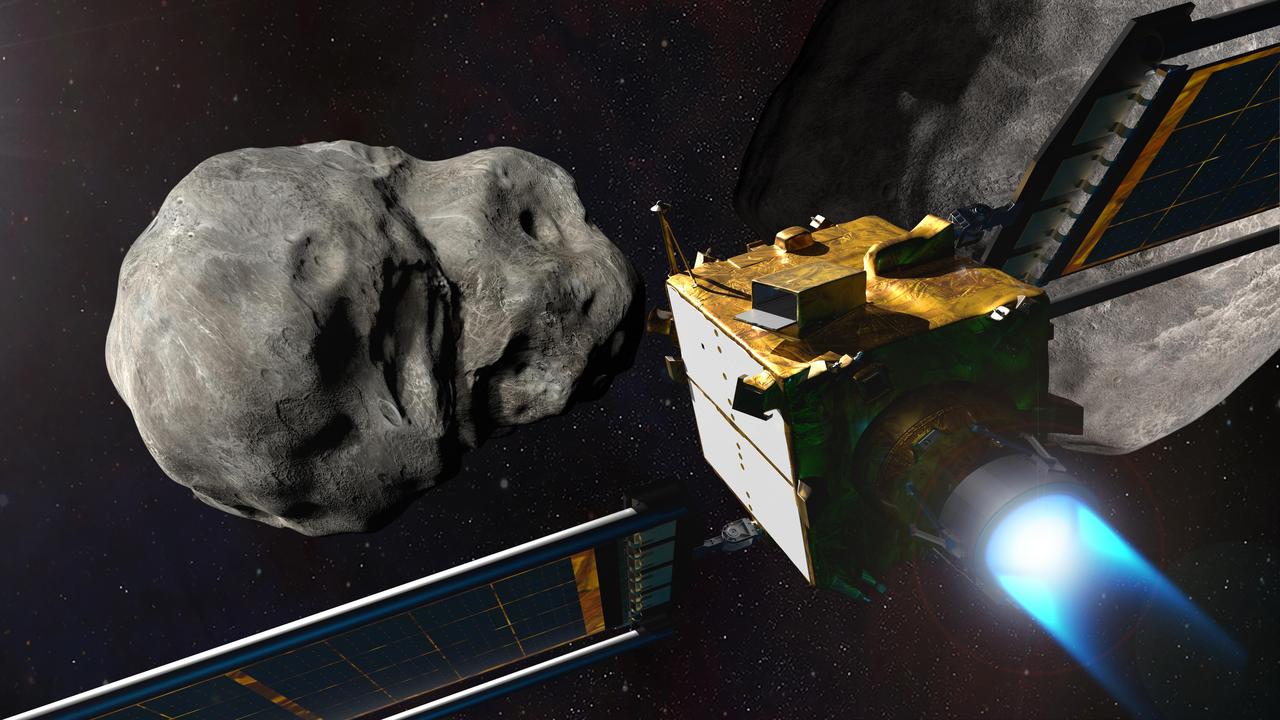
When NASA's DART spacecraft struck Dimorphos in September 2022, it shortened the moonlet's orbital period by 33 minutes. However, Earth-based telescopes could not directly weigh Dimorphos or inspect the crater concealed inside the debris cloud.
Hera completes the joint international AIDA experiment by conducting a close-up survey using its Asteroid Framing Camera, HyperScout-H hyperspectral imager, and thermal infrared sensors.
Operational distances and twin CubeSat deployment
As illustrated in the mission distance chart, Hera begins early characterization at 25–30 km before spiraling closer and releasing two shoebox-sized CubeSats: Juventas (carrying a low-frequency interior radar) and Milani (mineral and dust spectroscopy).
Tracking how Dimorphos' tiny gravity tugs on Hera will yield the moonlet's exact mass and bulk density for the first time.
Calibrating kinetic impact for planetary defense
Measuring the crater geometry, internal rubble-pile porosity, and momentum transfer efficiency turns DART's one-off collision into a validated engineering model for defending Earth against future hazardous asteroids.
Frequently asked questions
How long did Hera take to reach Didymos after launch?+
Launched in October 2024, Hera swung past Mars and Deimos in March 2025 for a gravity assist before arriving at Didymos in November 2026 (~25 months).
What will the CubeSats Milani and Juventas do?+
Milani maps mineral composition and surrounding dust, while Juventas conducts the first direct radar sounding of an asteroid's interior.
Verification Fact Sheet
Original source: European Space Agency (ESA Space Safety — Hera Mission)
Evidence: October–November 2026 rendezvous braking maneuvers and orbital telemetry.
Scope: Arrival at Didymos–Dimorphos (Nov 2026) at 25–30 km standoff distance.
Announced date: Nov 2026