NASA's CHAPEA Mission 2 Completes 378 Days of Simulated Mars Isolation
The four-person crew spent over a year inside Houston's 3D-printed Mars Dune Alpha habitat under realistic communication delays.
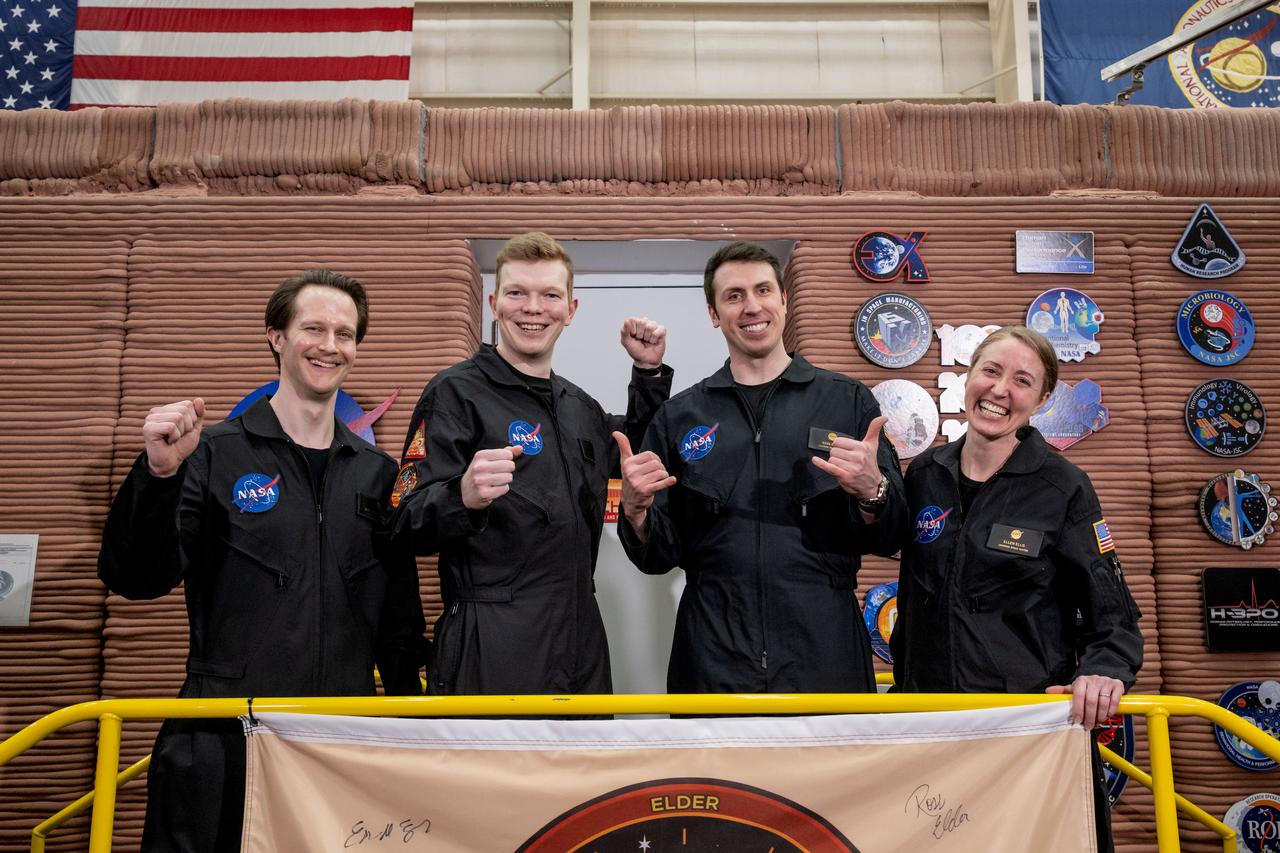
NASA's second Crew Health and Performance Exploration Analog (CHAPEA) mission concluded in 2026 after 378 continuous days inside the 3D-printed Mars Dune Alpha habitat in Houston, collecting physiological and behavioral data for future Mars voyages.
- 378 continuous days inside an enclosed ~158 m² (1,700 sq ft) habitat.
- Operated under realistic Mars communication delays and resource constraints.
- Included simulated Marswalks, hydroponic crop growth, and equipment failure drills.
Duration of Isolation Analog & Spaceflight Missions
Continuous mission days
Source: NASA JSC · CHAPEA simulates long-duration stays under Mars communication delays.
What NASA's CHAPEA analog program measures
Before committing astronauts to a multi-year round trip to Mars, NASA needs hard data on how a four-person crew handles prolonged confinement, limited shelf-stable food, and one-way radio delays of up to 22 minutes.
Inside Johnson Space Center's Mars Dune Alpha habitat, CHAPEA Mission 2 volunteers carried out simulated Marswalks, daily exercise, robotic operations, and fresh crop harvesting.
How 378 days compare to orbital missions
As shown in the duration chart, CHAPEA Mission 2's 378-day run matches CHAPEA Mission 1 (378 days), more than doubles a typical 180-day International Space Station (ISS) increment, and slightly exceeds NASA's longest single spaceflight record (371 days).
Unlike the ISS—where live audio with Mission Control is instantaneous—CHAPEA forces crews to troubleshoot technical anomalies independently.
Analog boundaries: what ground simulations cannot replicate
While ground analogs accurately test psychological isolation, nutrition, and autonomy, they cannot reproduce reduced Martian gravity (0.38 g) or deep-space ionizing radiation. NASA combines CHAPEA findings with ISS biomedical logs and Artemis lunar mission data.
Frequently asked questions
How many crew members lived inside Mars Dune Alpha?+
Four volunteers lived and worked inside the 1,700-square-foot habitat throughout the 378-day mission.
Did the crew have real-time calls with Mission Control?+
No during simulated Mars transit/surface phases, where signals were delayed up to ~22 minutes each way to match real Earth–Mars light travel time.
Verification Fact Sheet
Original source: NASA Johnson Space Center (CHAPEA Mission 2)
Evidence: Official 378-day Mars Dune Alpha analog mission log.
Scope: Duration (378 days), isolation, nutrition, and autonomous operations.
Announced date: Oct 2026