Webb Telescope reveals the hidden history of supernova Cassiopeia A
New infrared observations detail how stellar dust allows astronomers to reconstruct the internal structure of a massive star before its explosion.
The James Webb Space Telescope has captured high-resolution images of Cassiopeia A, a supernova remnant located approximately 11,000 light-years away. Analysis of the stellar dust suggests that the star's internal layers mixed just hours before its collapse, altering its final chemical composition.
- Webb used its MIRI instrument to map the composition of dust within the Cas A supernova remnant.
- Data indicates a merger of internal layers (oxygen and carbon) shortly before the stellar explosion.
- The study, published in The Astrophysical Journal Letters, helps reconstruct the final evolution of massive stars.
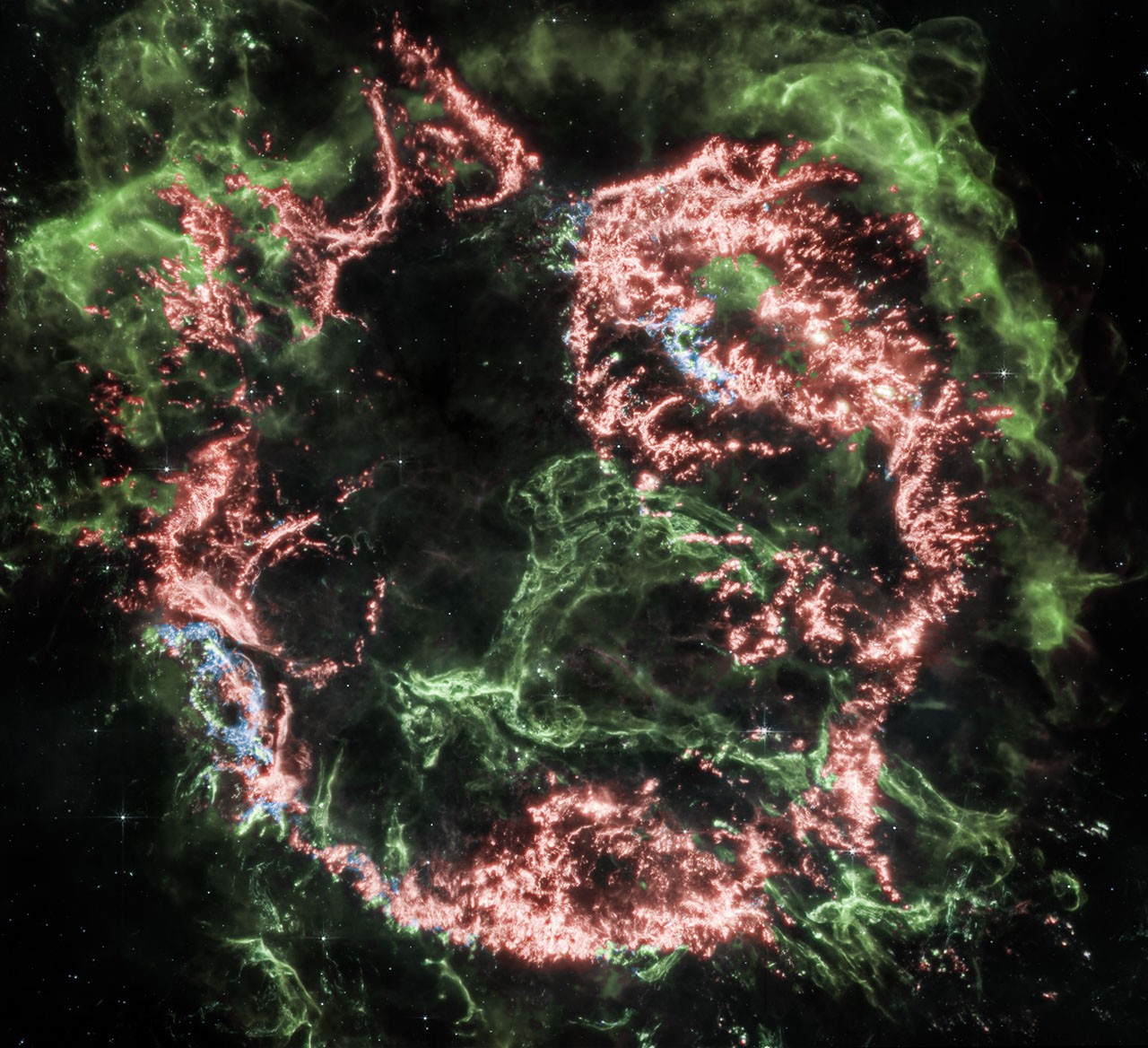
Methodology: Infrared mapping of stellar dust
The scientific team utilized the James Webb Space Telescope's MIRI (Mid-Infrared Instrument) to observe the Cassiopeia A supernova remnant. This technology detects the thermal emission of the hot dust that makes up the remnant structure following the explosion.
By mapping the chemical composition of these solar-system-sized dust clumps, researchers were able to identify the spectral signatures of heavy elements, allowing them to trace which layers of the original star produced each type of material.
Context: The evolution of a massive star
Massive stars function like cosmic onions: they fuse increasingly heavier elements in concentric layers, from hydrogen on the outside to iron in the core. When fuel runs out, the star collapses and explodes as a supernova, scattering these elements.
Comparison with standard stellar models shows that, in the case of Cas A, the structure was not perfectly stratified. Evidence suggests that oxygen and carbon layers mixed before detonation, a phenomenon known as shell merging.
Scientific scope and limitations
This finding is crucial for understanding how supernovae seed the universe with the elements necessary for future stars and planets. However, the study is limited to the interpretation of the chemical composition of the current remnant dust.
While the data provides a clear window into the star's final moments, the reconstruction relies on theoretical models of stellar nucleosynthesis, meaning future observations of other remnants will be necessary to confirm if this behavior is the norm or an exception.
Frequently asked questions
What is Cassiopeia A?+
It is a supernova remnant, a cloud of gas and dust resulting from the explosion of a massive star, located about 11,000 light-years from Earth.
Why is stellar dust important?+
Stellar dust contains the heavy elements created in the star's core. Studying its composition allows astronomers to understand the internal structure of the star before it exploded.
Verification Fact Sheet
Original source: NASA / The Astrophysical Journal Letters
Evidence: High-resolution observations from the MIRI instrument (James Webb)
Scope: Analysis of the chemical composition of dust in the Cas A supernova remnant
Announced date: Nov 23, 2026